|
Faculty
Armitage
Broholm
Chien
Judd
Leheny
Markovic
Reich
Robbins
Tchernyshyov
Tesanovic
Walker
Affiliated faculty
Dukan
Petrovic
Stiles
Postdocs
Anguelouch
Cvetkovic
Lee
Maloney
Nie
Stock
Trietiakov
PhD students
Cabrera
Cappallo
Chen
Cheng
Cheng
Chern
Clarke
Concha
Felton
Fehling
Guo
Hong
Hoy
Huang
Jonas
Kirschner
Lamb
Lapointe
Lee
Liang
Liu
Luan
Mellado
Merchant
Shang
Shelley
Singh
Stanev
Thampy
Valentine
Wasserman
Xia
Yardimci
Youk
Zhu
Zhu
Alumni
Ambrose
Bandyopadhyay
Bao
Belak
Cai
Chen
Childress
Davidovic
Dender
Denniston
Dukan
Franz
Freeland
Gasparovic
Gavrin
Gokemeijer
Herbut
Hsu
Ji
Ji
Jiang
Kenzelmann
Lacevic
Lee
Liou
Liu
Martys
Melikyan
Muser
Qiu
Qiu
Rottler
Silevitch
Singh
Stevens
Stone
Strijkers
Sun
Tanase
Unruh
Vafek
Xiao
Xiao
Xing
Xu
Yang
Zaliznyak
|
JHU Physics and Astronomy is featured
among the leading research departments nationwide in the latest
2006-2007 rankings by
Academic Analytics, placing well within the top 10 in both
physics and
astronomy & astrophysics. This is in line with PHA's high standings in
earlier
NRC-based and
Diamond & Graham rankings.
First in overall research funding, JHU as a whole
is also ranked in the top 10,
as are its Physical and Mathematical Sciences; click
here
for the rankings by broad fields and
here
for the list of top research universities.
Research
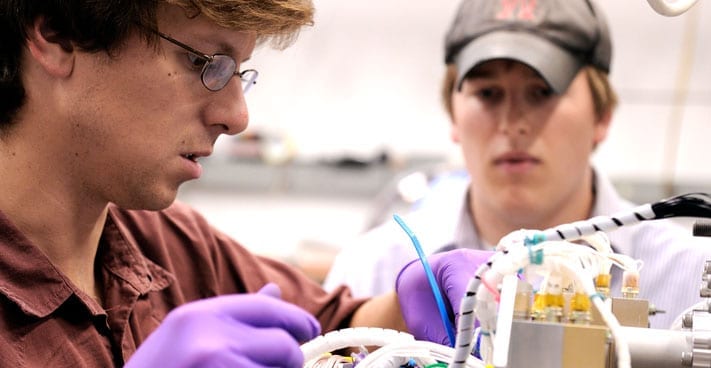
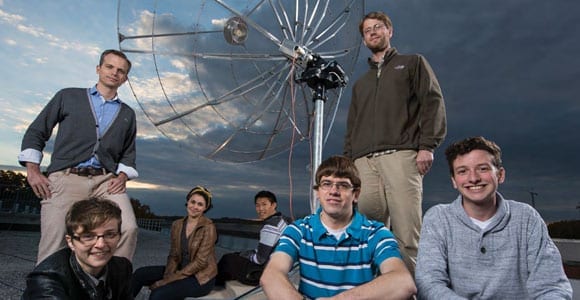
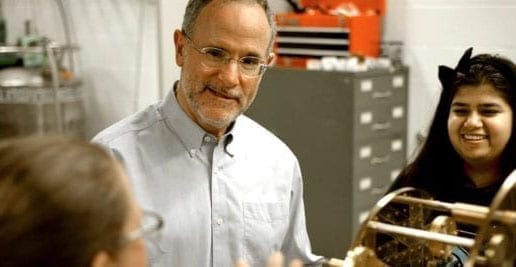
Our group maintains active experimental and theoretical
research programs at the forefront of both "hard" and "soft"
condensed matter physics. Examples
of the former are quantum magnets studied by neutron scattering
techniques (Broholm, Reich), experiment and theory of magnetic
nanostructures and quantum nanowires (Chien, Markovic,
Reich, Tchernyshyov, Walker),
broadband microwave and terahertz spectroscopy of correlated electron systems
(Armitage) and theory of
correlated magnets, rare-earth
metals and superconductors (Judd, Tesanovic, Tchernyshyov).
The latter includes dynamical studies of conformational transition in proteins
(Armitage),
x-ray and neutron scattering studies of glasses and out-of-equilibrium
complex fluids (Leheny), biological applications of nanostructures
(Markovic, Reich) and analytic and computer-aided theory of
non-equilibrium processes, adhesion and friction
(Robbins).
JHU is the home of Materials Research Science and Engineering Center
(MRSEC) on magnetic nanostructures and magnetoelectronics, a large NSF funded center for
interdisciplinary research in nanotechnology. Nearby
NIST, a large
government research lab and a premier US
facility for neutron scattering research, benefits from close
involvement of several JHU groups, most notably through a multi-million
dollar Multi Axis Crystal Spectrometer
(MACS),
conceived and built at JHU.
Our group is committed to interdisciplinary research in both
hard and soft physical sciences and takes
advantage of JHU's preeminent status in nanomaterials,
biophysical and biomedical sciences and bioengineering through numerous
interactions and collaborations with
Departments of Materials Science
and Engineering, Biophysics,
Biomedical and
Chemical and
Biomolecular Engineering, notably under the auspices of the JHU
Institute for NanoBioTechnology (INBT).
In addition, the JHU Applied Physics Laboratory has a large program in applied condensed matter
sciences and is a leading center in quantum optics and
optical quantum computing. Finally, the JHU's central
location in the Baltimore-Washington metro area places it at the heart
of one of the largest condensed matter science communities in the
United States.
Recent Highlights
Johns Hopkins scientists are at the forefront of the exciting new field of
iron-based high temperature superconductors. These new materials are different
from old copper-oxide-based HTS and offer a possible new pathway to room
temperature supercoonductivity and its many applications. See their paper in
Nature
and the JHU
press release.
The JHU led Partnership for Research and Education in Materials
(PREM) is chosen as a new NSF funded collaboration aiming to
enhance minority participation in
research and education in nanomaterials.
The PREM at Johns Hopkins, Howard University and Prince George's
Community College will receive $2.75 million over five years
and is one of six new such partnerships receiving a
total of $15.4 million from the National Science Foundation.
The others are California State and
Princeton universities; Jackson State University and the University of California, Santa Barbara; Norfolk State and Cornell universities; Tuskegee and Cornell universities; and the University of New Mexico and Harvard University. The full story is
here and
here.
Below are several links highlighting
the variety of research themes pursued by our group. More details
are available at web pages of individual faculty.
- "The BCS-like gap in superconductor SmFeAsO_0.85F_0.15",
T. Y. Chen, Z. Tesanovic, R. H. Liu, X. H. Chen, and C. L. Chien,
Nature 453, 1224 (2008)
- "d-wave Duality and Its Reflections in High-Temperature Superconductors",
Z. Tesanovic, Nature Physics 4, 408 (2008)
- "Bose-Einstein Condensation in Magnetic Insulators",
T. Giamarchi, Ch. Regg, and O. Tchernyshyov, Nature Physics 4,
193 (2008)
- "Magnetic microposts as an approach to apply forces to living cells", Nathan J. Sniadecki,
Alexandre Anguelouch, Michael T. Yang, Corinne M. Lamb, Zhijun Liu,
Stuart B. Kirschner, Yaohua Liu, Daniel H. Reich, and
Christopher S. Chen, PNAS 104, 14553 (2007)
- "Mesoscopic Phase Coherence in a Quantum Spin Fluid", Guangyong Xu, C. Broholm, Yeong-Ah Soh, G. Aeppli, J. F. DiTusa, Ying Chen, M. Kenzelmann, C. D. Frost, T. Ito, K. Oka, and H. Takagi, Science 317, 1049 (2007)
- "The Breakdown of Continuum Models for Mechanical Contacts",
Binquan Luan and Mark O. Robbins, Nature 435, 929 (2005)
- "Elastic Torque and the Levitation of Metal Wires by a Nematic Liquid Crystal",
C. Lapointe, A. Hultgren, D. M. Silevitch, E. J. Felton, D. H. Reich, and
R. L. Leheny, Science 303, 652 (2004)
Events & Activities
The main group activities include a weekly condensed matter physics
seminar,
journal club
and departmental
colloquium
where latest research developements are
discussed with a steady stream of visitors
from around the world. In addition, individual research groups hold
their own regular schedule of meetings, often in collaboration with
other JHU departments. Every year or two an especially distinguished
condensed matter physicist spends three days at JHU as a
Brickwedde Lecturer in Physics.
Centers, Research
Groups & Facilities
Johns Hopkins is the home of NSF funded MRSEC on magnetic nanostructures
and a large multidisciplinary Institute for NanoBioTechnology.
We also have an active scientific and instrumentation development program at the NIST Center for Neutron Research. State-of-the-art equipment
includes RF sputtering, Molecular Beam Epitaxy machine and laser ablation thin film deposition tools, a Focused Ion Beam writer, a class 1000 clean room, Scanning Electron and Scanning Tunneling Microscopy, several
Dilution Refrigerators for transport and magnetothermal measurements, a cryogenic system for neutron scattering at 11.5 Tesla and 25 mK, and a
64 node beowulf computing cluster as well as most advanced general
computing facilities.
Contact
Emails and phones
Click on the name in the left panel to get to the web pages,
needed email addresses
and/or phone numbers of an individual group member.
Regular mail address
Department of Physics & Astronomy
Bloomberg Center
Johns Hopkins University
3400 North Charles Street
Baltimore, MD 21218
|
Group/MRSEC manager
Ms. Sharon Karsk
Bloomberg 325
Email: karsk@pha.jhu.edu
Phone: 410.516.8429
Fax: 410.516.7239
|
Group/MRSEC coordinator
Mr. J. Woodland Pomeroy
Bloomberg 327
Email: woodland@pha.jhu.edu
Phone: 410.516.7381
Fax: 410.516.7239
|
Visitors
Our group welcomes visitors interested in exchange of scientific ideas and
research collaborations. The best way of arranging a visit is to contact the
faculty member(s) in your area of interest, preferably by email or phone. The
directions to Bloomberg Center are
here.
Various links of interest in the Baltimore-Washington metro area are
here.
Interested in PhD program at JHU?
If you are planning on pursuing PhD studies in condensed matter physics
you should be aware that the Johns Hopkins University has much to offer
to a talented and ambitious graduate student
as one of the leading educational and research
institutions in the United States
(see various
rankings).
We have a well-balanced graduate student body
with many international, female and minority students.
Alumni of our group go on to occupy prominent positions in academia,
government and industrial research laboratories, and various
financial and business institutions. If you would like to
apply for graduate study at JHU
this web
page has all the
relevant information on our PhD program including the application forms:
http://www.pha.jhu.edu/admiss/grad/.
|